
Africa, Ethiopia of great diversity
Ethiopia is a fascinating destination where history, culture, and nature intertwine in unique ways. Considered the cradle of humanity, the country boasts an exceptional heritage, from the rock-hewn churches of Lalibela to the imperial castles of Gondar.
Its landscapes are equally impressive: the Simien, the Rift Valley lakes and the spectacular volcanic formations of Danakil, one of the most extreme places on the planet.
Ethiopia is also renowned for its rich culture, with over 80 ethnic groups, ancient traditions, and unique cuisine. A trip to Ethiopia is an authentic, intense, and profoundly enriching experience, perfect for travelers seeking history, adventure, and unforgettable encounters.


14 days from €3,215
Confirmed from 4 people
Difficulty: 2/5
The pluses of this program
Hiking in 3 very different National Parks.
Visit to the two most emblematic cities of this part of the Adriatic (Dubrovnik and Kotor)
Accommodation in Biogradska National Park in the comfortable cabins/chalets typical of the local shepherds.
A vibrant culture and traditions, and hospitable inhabitants.
Program
〰️
Program 〰️
-
Arrival in Addis Ababa – visit – flight to Semera towards Danakil
Arrival at the airport and welcome by the guide.
As soon as you arrive in Addis Ababa—the capital of Ethiopia—you're immediately struck by its altitude, perched at 2,500 meters. This record makes it the highest capital city in Africa and the fourth highest in the world. The morning begins with a local breakfast, followed by an immersion in the city's historical heart: the National Museum, home to the famous Lucy, or Dinknesh, "the marvelous one" to Ethiopians, and where you can admire a replica of her skeleton. In the afternoon, we head to the airport for a flight to Semera, the capital of the Afar region. After settling into the hotel, the day concludes with dinner under the stars in this land of contrasts.
Hotel accommodation
-
Descent into the Afar Depression (Danakil) – Lake Afdera - Erta Ale
Dawn in the distance: At dawn, the 4x4 convoy sets off for Erta Ale, crossing a mineral landscape where lava deserts and volcanic expanses stretch as far as the eye can see. The spectacle is breathtaking.
Stops and discoveries. Around midday, we pause on the shores of Lake Afdera, a salt lake lying one hundred meters below sea level, surrounded by salt marshes. We have the opportunity to explore its shores, hot springs, and evaporation basins before settling into a local restaurant for a typical lunch, while we finalize the arrangements for our ascent of the volcano.
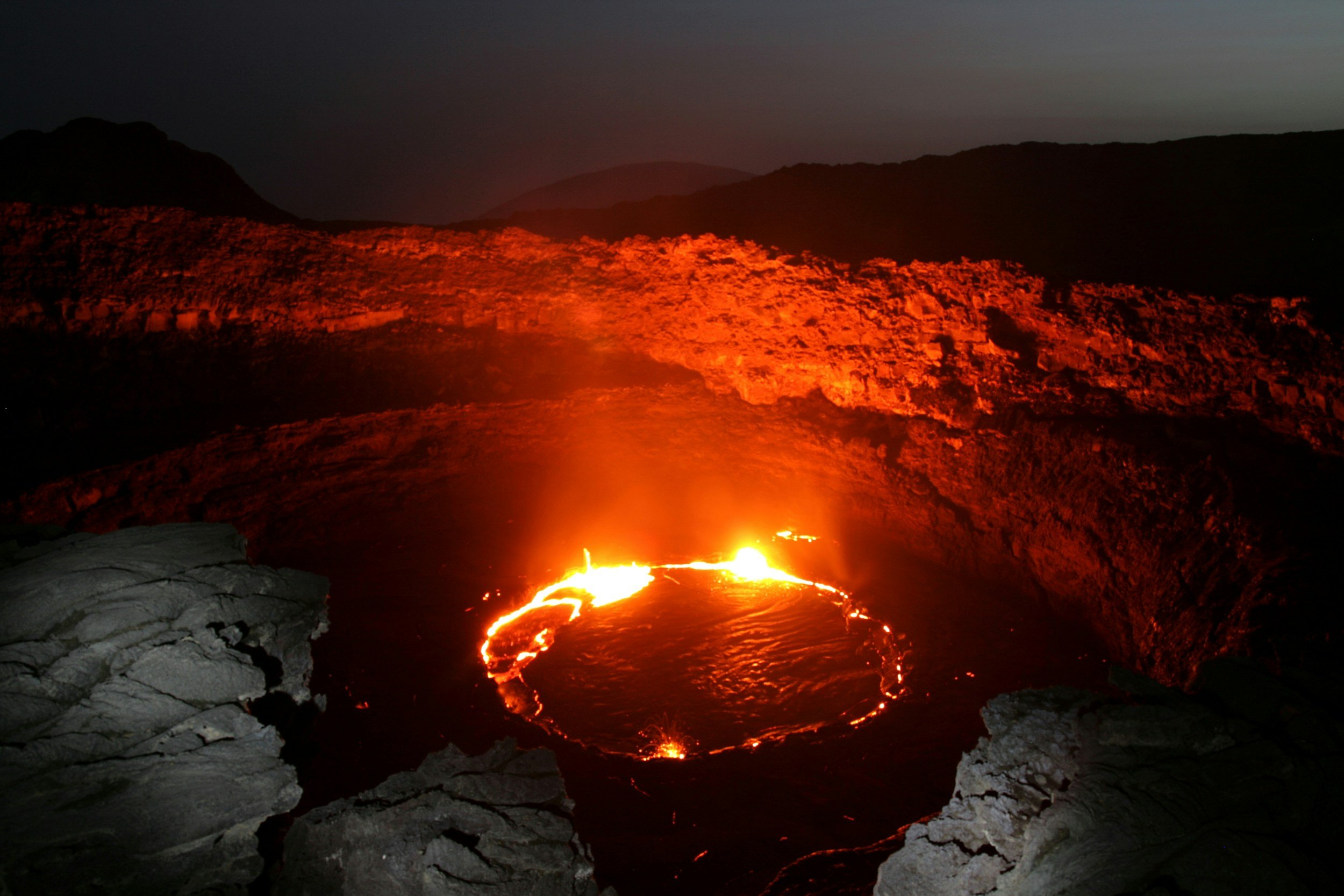
To the lava giant: In the afternoon, the trail finally leads to the Erta Ale base camp. After settling in, it's time to explore the caldera and its craters, a fascinating sight, both day and night. At night, travelers take refuge in volcanic rock shelters, three people per shelter—or in tents, if they prefer.
A world apart: the Afar Depression, land of the Afar nomads, lies at the crossroads of the Rift Valley, the Red Sea, and the Gulf of Aden. Here, the heat is extreme, the landscape harsh, but it is also one of the few places where an open mid-ocean ridge emerges. Between Africa and Arabia, earthquakes are frequent, a reminder of the power of the forces at play.
Erta Ale, a giant awakening: Reaching 613 meters, Erta Ale is a shield volcano with gentle slopes, spread over a base 30 kilometers in diameter. Its southern crater, 140 meters wide, contains a lava lake whose depth varies depending on activity. To facilitate the ascent, two saddle camels accompany the group, ready to assist those exhausted from the hike.
Driving time: 4h30
Hike: 2h30
Accommodation: bivouac
-
A day between fire and ice: Erta Ale, Amedila and the salt ice
In the heart of the volcano: at dawn, return to the Erta Ale caldera to explore the north and south craters, where the molten lava lake is revealed in a new light. The shadows and reliefs, transformed by the first rays of the sun, offer an ever-renewing spectacle.
From lava to palm trees: The descent to base camp marks the beginning of an hour-long hike to reach the 4x4s. Head to a verdant oasis: a palm grove where you can improvise a meal in the shade of the trees before returning to Amedila. This village, situated 100 meters below sea level, lies at the gateway to the salt flats, with the Dallol volcano rising on the horizon. The camp is set up in a vast palm grove, a haven of coolness amidst the aridity.
On the salt ice: In the afternoon, the group heads to the salt ice for a first exploration of the area around Dallol, a lunar landscape with otherworldly colors. At the end of the day, we stop near the salt lake Karoum: we enjoy an aperitif while watching the sunset over the bright white expanse of the ice floe.
Back under the stars: At the end of the afternoon, the convoy returns to the palm grove where dinner ends on this intense day, amidst the flames of the volcano and the serenity of the salt landscapes.
Hike: 2h
Accommodation: Camping
-
An immersion into traditions and lunar landscapes: The Saba palm grove, Dallol and the salt ice
Tomorrow: Between salt and sulfur
At dawn, we set off for the salt flats, where the Afar workers, present from sunrise several days a week, extract blocks of salt using ancestral methods. An immersion in time-honored know-how, to the rhythm of precise gestures and traditional tools.
Next, head to the Dallol volcano, a geological site unlike any other in the world. After an approach hike, the crater reveals its petrified salt chimneys, crystalline cave, and acidic basins in iridescent colors—sulfur yellow, ochre red, emerald green. After a refreshing break, the group discovers the potassium lake, or black water, whose dark water contrasts sharply with the sunlit floor. The visit ends at Petit Dallol, where a crater of sulfurous water bubbles up, a reminder of the volcanic activity that still persists.
At the end of the morning, return to the Saba palm grove for lunch and enjoy a well-deserved rest in the shade of the palm trees.
Afternoon: Meetings and traditions
In the afternoon, a walk leads to a traditional Afar village, where you can witness the coffee ceremony, a convivial ritual emblematic of the region. This is a moment for sharing and discovering local customs, before returning to the camp for dinner and spending the night under the stars.
The Dallol: a geological gem
Dallol, a volcanic crater located below sea level, is famous for its spectacular mineral formations: hot acidic springs, sulfur mountains, salt columns, gaseous geysers, and colorful basins (white, yellow, green, and ochre-red), the result of the presence of sulfur, iron oxide, and magnesium chloride. It is the only place in the world where such structures exist. At the heart of the site, a ghost town, an old potash mine abandoned by the Italians in the 1930s, bears witness to a bygone era.
Hike: 3h
Transfer: 2h
Accommodation: bivouac
-
Semera - Awash Dam - Ceremony at Mile Church - Semera
The sun is barely up as we drive towards Mile along a track that winds through the semi-arid plains. After about sixty kilometers, the landscape changes: first there's the Awash Dam, a tranquil expanse of water that contrasts sharply with the surrounding aridity. Distant shepherds, wrapped in their sanafil (traditional cloths), guide their flocks to the watering points.
A little further on, a geothermal field is revealed, where fumaroles escape from the cracked ground, exhaling a pungent sulfurous odor. An Afar guide explains the hot springs, which have been used for generations for their therapeutic properties.
Encounters with the Afar people and the savanna. The hike begins, and all around us we see nomadic villages with huts made of branches and hides, where women adorn themselves with necklaces of colorful beads, pound grain, or woven mats. Further on, an endemic wild boar, recognizable by its prominent tusks, roots its snout at the ground, while an oryx stands out on the horizon with its long, straight, sword-like horns.
Mile and the emotion of Sainte-Marie. Our arrival in Mile coincides with prayer time. We visit the Church of Sainte-Marie, a small white stone building with thick walls where a religious ceremony is taking place. The faithful, dressed in white, sing in Amharic. We are witnessing a ceremony charged with palpable fervor.
Return to Semera: Lunch, enjoyed in the shade of a centuries-old acacia tree, is a well-deserved moment of rest. The spicy flavors of the local dishes are delightful. Afterward, the journey continues toward Semera, passing by a variety of landscapes: endless steppes, distant mountains, and, occasionally, the mirror-like surface of a salt lake shimmering in the waning sun.
At the end of the afternoon we arrived at our hotel, whose mud walls offered a welcome coolness after such a busy day.
Hike: 3h30
Transfer: 1h30
Accommodation: Hotel
-
ADDIS ABABA → JINKA – MEETING WITH THE MURSI
Flight Addis Ababa → Jinka. Upon arriving in Jinka, a village situated on a plateau at an altitude of about 1,500 meters, you are greeted by a landscape of arid hills dotted with acacia trees and thorny bushes. The 4x4 road to Mago National Park crosses dry savannas, where giant termite mounds dot the horizon. The park, located at the confluence of the Karo, Mursi, and Harar territories, stretches along the muddy meanders of the Mago and Omo rivers, bordered by gallery forests and marshy areas.
Meeting the Mursi: The Mursi villages, located on the edge of the forest, are surrounded by fields of sorghum and maize, often protected by branch fences. The huts, built of wood and earth, are covered with thatched roofs. The atmosphere is peaceful, disturbed only by the sounds of children playing and the singing of local birds.
In the afternoon, the Ethnographic Museum offers a panoramic view of the surrounding hills. The descent to the central market is along dusty paths lined with small shops piled high with spices, colorful fabrics, and pottery.
Ground transfer: 2h
Accommodation: Hotel
-
JINKA → TURMI – AT THE HAMER HOUSE
Route to Turmi: The trail winds through rocky plateaus and verdant valleys, where cacti and euphorbias thrive. The Hamer, Bana, and Ari villages are easily recognizable by their circular stone enclosures, surrounded by cultivated fields. The landscape alternates between semi-desert areas and oases of doum palms.
Hamer villages are typically built on gentle hills, offering unobstructed views of the savanna. The dome-shaped houses are covered with thick thatched roofs. Women's body paint and beadwork add vibrant color to this natural setting.
Transfers: 3h
Accommodation: Hotel
-
TURMI → THE KARO, GUARDIANS OF THE OMO
Meet the Karo. The village of Douss is perched on a cliff overlooking the Omo River, offering breathtaking views of the river's muddy meanders and islands of dense vegetation. The Karo cultivate their fields in terraces, where millet, sorghum, and bananas grow. Nile crocodiles, visible from the riverbanks, are a reminder of the region's wild power.
Take a stroll along the Omo River. The riparian vegetation consists of reeds, acacias, and wild fig trees, while the gallery forests are home to a discreet array of wildlife. Tall, isolated baobab trees dominate the landscape, their enormous silhouettes etched against the blue sky.
Duration : 2 hours of visit/meeting
Accommodation : Hotel in Turmi
Transportation : 4x4 (80 km)
-
TURMI → KONSO – THE MASTERS OF THE STANDS
The road to Konso winds through increasingly verdant landscapes, marked by terraced hills and fertile valleys. The villages, clinging to the mountainsides, are surrounded by dry-stone walls, typical of the region.
Discovering Konso: The terraced, meticulously landscaped fields are planted with grains, coffee, and bananas. Wakas, carved wooden totem poles, stand in the center of the houses, reminders of the importance of the ancestors. The lodge, surrounded by flower gardens and fruit trees, offers relaxing views of the surrounding hills.
Duration : 2 hours of visit/meeting
Accommodation : Lodge in Konso
Transport : 4x4 (160 km)
-
KONSO → ARBAMINCH – THE COFFEE ROUTE
Crossing the Sidamo Region: The route traverses the Sidamo region, known for its rolling hills covered in coffee trees and eucalyptus forests. The villages, often built on higher ground, overlook fertile valleys through which streams flow.
Arrival in Arbaminch. The town, situated at an altitude of 1,200 meters, is surrounded by lakes with azure waters and forested mountains. The lodge, located on a wooded hillside, offers breathtaking views of Lake Chamo and Lake Abaya.
Meeting the Dorze: The Dorze houses, shaped like beehives, are built of bamboo and straw. They fit perfectly into a landscape of bamboo groves and banana plantations, where the false banana (enset), the basis of the local diet, is also grown.
Duration : 2 hours of visit/meeting
Accommodation : Lodge in Arbaminch
Transport : 4x4 (130 km)
-
ARBAMINCH – LAKES AND CROCODILES
Lake Chamo is lined with reeds and papyrus, its waters calm and blue. Azzo Gabaya beach is covered with Nile crocodiles, some motionless like statues, others gliding silently through the water.
The fishermen and farms are surrounded by banana plantations and cornfields, while the fishermen bring in their catch of the day in their papyrus boats.
Duration: 1h30 visit
Accommodation: Lodge in Arbaminch
Transport: Minibus (30 km)
-
ARBAMINCH → ADDIS ABABA – RETURN TO THE CAPITAL
Latest discoveries in Arbaminch: The lively and colorful Arbaminch market sprawls through dusty alleyways piled high with fruits, vegetables, spices, and fabrics. The surrounding, verdant mountains provide a spectacular backdrop.
Farewell dinner in Addis Ababa. Back in the capital, the Cultural Museum and the University Palace offer a contrast to the rural landscapes of the previous days. Dinner, at a traditional restaurant, is accompanied by Ethiopian dances and songs, marking the beginning of this journey to the heart of wild and authentic Ethiopia.
Important information
-
Simple but clean hotels, campsites.
-
David Casajuana and a second local guide.
-
1 to 4 hours of walking per day. Little difference in altitude.
-
Between 4 and 14 people
-
Luggage and portering: there are no porters except for day-use belongings
Prices and conditions
PRICE FROM €3,215
Included in the price: domestic flights (3 flights: Addis-Semera // Semera-Jinka // Arbaminch-Adis), accommodation (or camping) with breakfast from day 1 to day 12 in a shared double room, 10 picnic lunches or dinners during the treks, dinner from day 2 to 11 in traditional restaurants, transfers as per the program, luggage transport between accommodations, guide (David Casajuana) and local team, and tourist tax.
Not included in the price: international flight, meals on day 1. Meals are included on day 12, except for breakfast. Drinks, personal expenses, tips, or any service not mentioned in the "included in price" section above are not included.
Single room supplement and plane tickets: please ask us